Publication Launch

cover_gradations


Gradations of Time over Plane
29 June / 30 June / 13 July – 2012  (London & Porto)
#PUBLICATION LAUNCH

.Inc, Porto – Friday – 13 JULY, 6:00pm
O lançamento tem hora marcada para as 18h00 da próximo Sexta-Feira, dia 13 de Julho no Porto, na Inc. livros e edições de autor.

.Gasworks, London – Friday – 29 JUNE, 8pm

.X Marks the Bökship, London – Saturday – 30 JUNE, 6:30pm
Gradations of Time over a Plane is a publication on the open-ended project
by the artists Mariana Caló & Francisco Queimadela.
Texts by Filipa Ramos and Coline Milliard
Graphic Design by Rui Silva

“Gradations of Time over a Plane” é uma publicação que reúne uma série de capítulos do projecto contínuo da dupla de artistas Mariana Caló e Francisco Queimadela. Esta publicação foi desenvolvida em residência na Gasworks em Londres, com o apoio da Fundação Calouste Gulbenkian e inclui textos de Filipa Ramos e Coline Milliard. Design Gráfico de Rui Silva.
*Agradecimentos especiais: Rowan Geddis, Isabel Lucena, Rowing Projects, John Holten

Supported by Calouste Gulbenkian Foundation and Gasworks
*A big thank you to Filipa Ramos, Rowan Geddis, Rowing Projects and John Holten


CHART FOR THE COMING TIMES

chart-07


Exhibition at Rowing Projects invited by Tyler Woolcott and Guillaume Breton
Preview : 22nd of June
Open: 23rd of June until the 4th of August

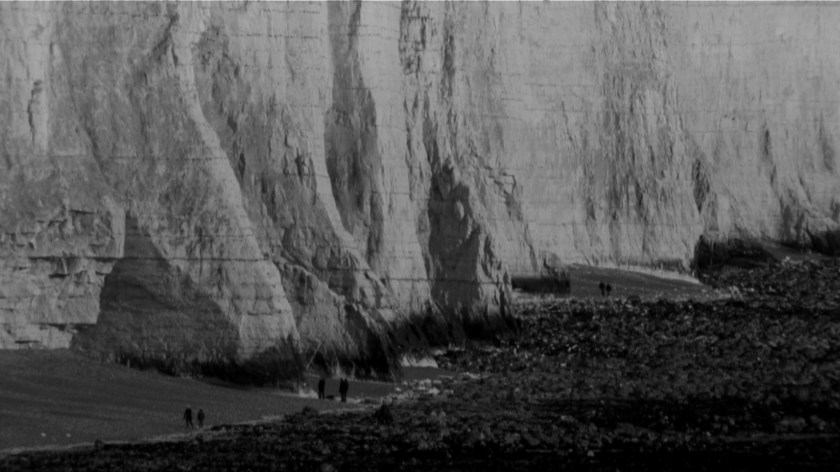
“Rowing Projects is pleased to present Chart for the Coming Times, a solo exhibition developed by the Portuguese artists duo Mariana Caló & Francisco Queimadela. This video installation is a new chapter of the artists open-ended project entitled “Gradations of Time Over a Plane”. Composed of a black and white video, a hand-painted book and a pile of 1,000 printouts-this work is centered on the idea of communication in time by combining the notions of intentional and unintentional time capsules, in relation to the particularities of a specific location, the chalk cliffs of the area of Cuckemere Haven and Seven Sisters (East Sussex, UK).”

http://www.rowingprojects.com
443-449 Holloway Road, Unit F, N7 6LJ – London


GRADATIONS OF TIME OVER PLANE

gradacoes_derivas-6

Exhibition at Gasworks – 27th, 28th, 29th of April 2012

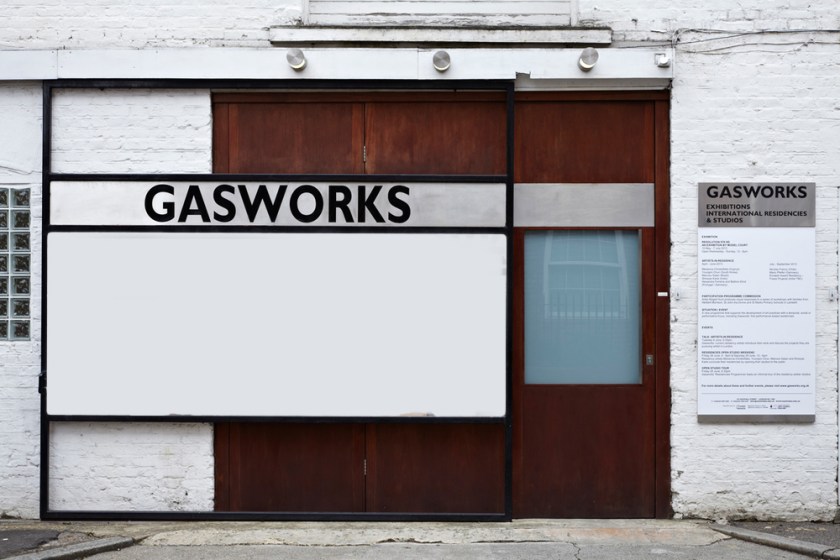
Current artists in residence Mariana Caló and Francisco Queimadela present several chapters from their ongoing project Gradations of Time Over a Plane. The installation includes a new chapter entitled Drifts and Derivations, developed during the artists’ residency at Gasworks.

Working with film, photography, illustration and sculpture, the artist duo has been developing Gradations of Time over a Plane since March 2010. Made up of non-sequential chapters, each of them independent but brought together through the installation, the work explores different notions of time in relation to Man and the Land. Forming relationships with and then filming in various locations in the north of Portugal, UK, the Netherlands and Germany, the artists seek to capture what they see as the temporal essence of different landscapes. This field work is accompanied by extensive research into and deconstruction of various popular, scientific and artistic perspectives on the relationship between Man and the passing of time. The resulting works take the form of immersive installations that offer personal perspectives whilst seeking to involve the viewer as a free interpreter of the visual experience.

The new chapter will be presented alongside a previously composed sequence of video chapters, with a connecting soundtrack drawing together both parts of the temporary installation. The resulting dialogue between new and existing work makes visible an expansion of ideas of the first sequence in the new chapter, but can also be seen as a parallel discourse, in which the new work presents a modification of the original ideas.

Born respectively in Viana do Castelo and Coimbra, Portugal, Mariana Caló & Francisco Queimadela currently live and work in Berlin.
Their residency is supported by The Calouste Gulbenkian Foundation.

This event is part of SLAM Last Fridays.

Gasworks, 155 Vauxhall Street – London SE11 5RH


OPEN STUDIOS

open


OPEN STUDIOS
Friday, 30th  (18h – 21h) + 31st (12h-18h), March 2012
Gasworks (London)

Artists Mariana Caló & Francisco Queimadela, Boris Dornbush and Ritesh Meshram conclude their residencies by opening their studios to the public.

+
Saturday, 31st  of March
15h – 17h

FILM PROGRAMME: Of Time & Place

An afternoon of artists’ films, programmed with current artists in residence Mariana Caló & Francisco Queimadela, The programme includes works by artists who have influenced Caló & Queimadela’s practice as well as films by other artists sharing similar formal or conceptual interests.

Featuring films by:
Ben Rivers, Dinis Santos, João Maria Gusmão & Pedro Paiva, Mónica Baptista and Regina De Miguel.

ARTISTS IN RESIDENCE AT GASWORKS

gasworks


Mariana Caló and Francisco Queimadela are artists in residence at Gasworks, from January to June 2012, supported by Fundação Calouste Gulbenkian.

Related events:
01-02-2012 – 19h – Gasworks (London)

ARTISTS TALK
Mariana Caló & Francisco Queimadela (Portugal) and Ritesh Meshram (India) give a brief overview of their practices, focusing on key works as well as discussing projects to be developed during their stay at Gasworks.

http://www.gasworks.org.uk/


SPRINGS OF THE FLOOD

springs01


Exhibition at Matador Projekt Raum
25-11 to 17-12 de 2011  – Altes Finanzamt (Berlin)

For this exhibition at Matador Projekt Raum we are presenting the first draft of a new chapter from our ongoing work entitled “Gradations of Time Over a Plane”.
This project focuses on the reflection and interpretation of the notion of Time, both as a symbolic dimension of reality and also as an abstract concept that relates to something which is non-material and that ‘precedes materiality’. It is being constituted in chapters, reflections and articulations from the experience given by the field work (developed in different geographical contexts), combined with the interpretation and research of various perspectives on the relation between Man and the passing of time.

With “Springs of the Flood” we want to devise a video installation that mirrors the problematization of the present waves of questioning and reformulation, that are taking place in several places around the world, establishing a relation between two main axis of reflection: The myth of the Deluge and the unfolding of reality.

The exhibition can be visited during the regular events at Altes Finanzamt

Schönstedtstraße 7 – EG Neukölln 12043 Berlin

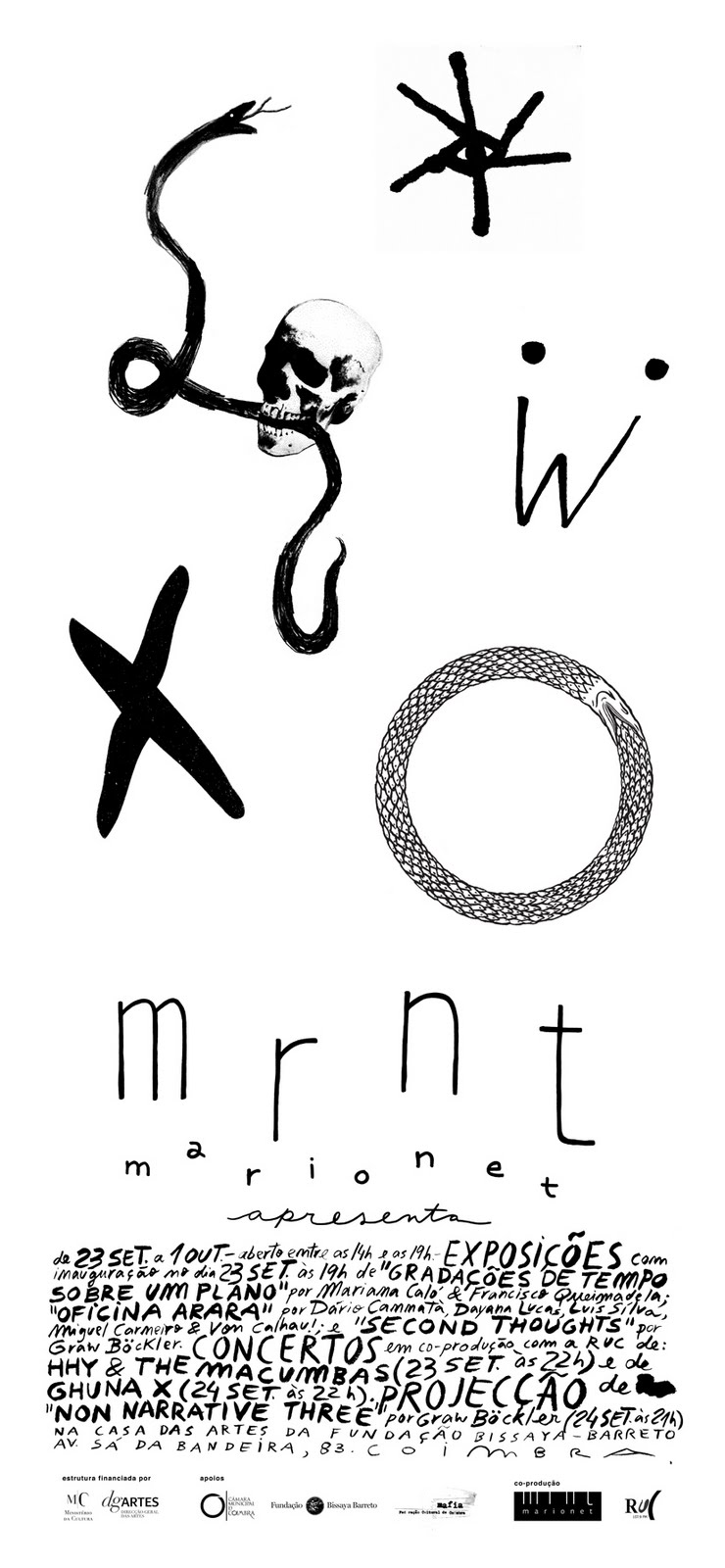
GRADAÇÕES DE TEMPO SOBRE UM PLANO

3911f-cartaz-coimbra-xxx-final


Exposições a convite da Marionet
23-09 a 01-10 de 2011
Casa das Artes Fundação da Bissaya Barreto(Coimbra)

.”GRADAÇÕES DE TEMPO SOBRE UM PLANO” por Mariana Caló & Francisco Queimadela
.”OFICINA ARARA” por Dário Cannatà, Dayana Lucas, Luís Silva, Miguel Carneiro & Von Calhau!
.”SECOND THOUGHTS” por Graw Böckler.

Concertos de
.HHY & THE MACUMBAS (23 SET. às 22h)
.GHUNA X (24 SET. às 22h)

Screening:
.NON NARRATIVE THREE por Graw Böckler (24 SET. 21h)

cartaz: dayana lucas / oficina arara

Autofocus { and meantime belongs to becoming }

Kuratiert von den Members of the General Public
Heimo Lattner, Marie-josé Ourtilane und Michael Schultze
02 – 11 September, 2011

Ulf Aminde, Astali/Pierce, Manon Bellet, Mariana Caló & Francisco Queimadela, Discoteca Flaming Star, Jeremiah Day, Kane Do, Sophie Hamacher, Hervé Humbert, Eva Meyer Keller, Annette Kisling, Stephanie Kloss, Käthe Kruse, Heimo Lattner, Marie-josé Ourtilane, Andreas Schimanski, Michael Schultze, Elke Marhöfer, Jonathan Monk, Martina Wolf

Umwälzungen in Nordafrika, tumultartige Verwerfungen der Geldwirtschaft, Natur- mit beigestellten Atomkatastrophen, Schuldenkrisen, all diese Ereignisse in den täglichen Blättern: wie aus dem Nebel oder aus einer Unschärfe heraus treten diese Momente einer kommenden Geschichte auf uns zu.
Scheinbar aus dem Nichts erscheinen sie aus dieser Unschärfe und rasten in einem spontanen Moment einer Scharfstellung in unser Bewusstsein ein, in den Lauf der Welt.

Der Begriff, mit dem alle diese Ereignisse sich in der medialen Öffentlichkeit tarnen, ist der der Krise. Dieser Begriff scheint recht präzise einem hypochondrischen Kapitalismus zu entsprechen, wir nehmen ihn ernst und umarmen ihn.
Was uns daran interessiert ist das Aufblitzen des zentralen Zeichens dieser Rede: dem unwillkürlichen Scharfstellen in ein Ereignis hinein, dass alles um sich herum in Unschärfe fallen lässt. Als Bild hierfür bietet sich das spontane Fokussieren des Autofokus mit seiner schmalen scharf umrissenen Zone und dem weiten Teil der Unschärfe dankend an.

In diesen Zeiten einer Rhetorik sich ablösender Krisen, in der die Rede von der Verknappung (in den diversen „Schuldenkrisen“) eine Maßlosigkeit der Ökonomie offenbart, und unscharfes Kapital hysterisch neue Orte der Sicherheit und der Akkumulation sucht, scheinen uns die Fragen nach dem Moment des Aufscheinen der unscharfen Ränder des gemeinschaftlichen notwendig:
Die Rhetorik der Krise kennt weder Vor- noch Nachher, sie ist die Leerstelle eines Wissens um Kontinuität, sie ist die Momentaufnahme mit Blitz einer leer laufenden Welt. Nur erinnert als verblasstes Blatt in einem Notizbuch, als ein unscharfes Bild in einem Familienalbum.

Die versammelten Künstler ziehen ihre Argumente, ihre Methoden und ihr Vorgehen nur im aller weitesten aus dieser Thematik: allen gemeinsam ist jedoch ein Vorgehen in der der Nebel genauso eine Rolle spielt wie der Tunnel (am Ende ein Licht?). Stillstand, Plötzlichkeit, leises Fallen und unscharfe Ränder, selbst die Geologie spielen eine Rolle.

Auch darum die letzte Station, die erste Station: Geologie. Endloses Freilegen, Bewegungen in höchster Zeitlupe. Darauf, auf der Tektonik der Erdkruste der Mensch in seiner Notwendigkeit das bestehende zu Ändern. Vor dem Ereignis: die Naturgeschichte. Nach dem Ereignis: die Unschärfe der Geschichte.
(Es besteht eine Relation zwischen der Geologie, der unendlich langsamen Bewegungen der Erdgeschichte und der sprunghaften, eruptiven Gewalt des Ereignisses das ihr Bild in dem blitzschnellen Autofokus einer Kamera findet).

Noch einmal: Die Rhetorik der Krise belässt einen immerzu im unscharfen, sie findet statt in jenem Schärfepunkt eines plötzlichen, unmittelbaren, ungeheuer aktuellen Jetzt. So belässt sie uns im unklaren über ihre Herkunft und ihre mögliche Lösung, sie ist wesentlich undialektisch und auf verschlingende Konsumtion dieses seltsam lähmenden wie ergreifenden Spektakels gerichtet. Abgelöst nur von jenem nächsten Ereignis, der nächsten Krise, die die Vorherige wieder in die milde Unschärfe eines vorher entlässt.
Im Konsum der Krise ähneln wir den konsumaffinen looters der englischen Insel, die den sozialen Protest in ein Fest der Konsumtion verwandelten. Plündern wir doch auch in der Wahrnehmung der vielfältigen Krisen den Moment der Schärfe des gnadenlosen Jetzts, und feiern mit Angstlust darin ebenso ein Fest der Vernichtung: Der symbolischen Werte (Nordafrika), der realen Werte (in den vielfältigen ökonomischen „Krisen“) – und vielleicht des Begriffs von Wert schlechthin.

Warum ist nun die Geologie in diesem Zusammenhang interessant? Sie ist das Modell dass der neuen Unschärfe beigestellt ist, und darin ist sie durchaus Janusköpfig. Wir sehen den Übergang von Geschichte in Geologie (in Naturgeschichte) mit einer faszinierten Skepsis zu. Robert Smithson, der in dieser Ausstellung als einer der Paten agiert, versuchte der Geologie (noch) eine revolutionäre Kraft abzugewinnen als ein Modell des großmaßstäblichen in Aufbau und Verfall, als einem Versuch die Dialektik in diesen ungeheuer langsamen Prozess hineinzuadieren.
Das Modell der Geologie dient uns als ein unendlich stillgestelltes Lager. Kaum merklich bewegt dieses sich. Demgegenüber: der Sprung. Das abrupte Aufscheinen des Ereignisses, das ins Licht stellen des entscheidenden Moments. Aus der Unschärfe heraus löst sich ein Bild – das Ereignis. Was passiert nun in dem Bereich der vor und hinter einem Ereignis liegt?
Dieser Frage wegen spielen wir das Ereignis gegen die (endlose) Zeit aus. Wir rechnen die Unschärfe in das jetzt hinein. Wir betrachten die Geologie als dialektischen Prozess. Und unabhängig von der gezeigten Kunst, die Vielfältig diese Fragen umklammert, stehen wir ratlos einer Ereignisshaftigkeit der Welt gegenüber, die, wie ein Zoomobjektiv den Fokus sucht, von Fukushima nach Griechenland zu den Ökonomischen Verwerfungen springt und die unsere neue Erdkruste markiert.

Michael Schultze

http://www.generalpublic.de
Schönhauser Allee 167c
10435 Berlin